ThankBooks

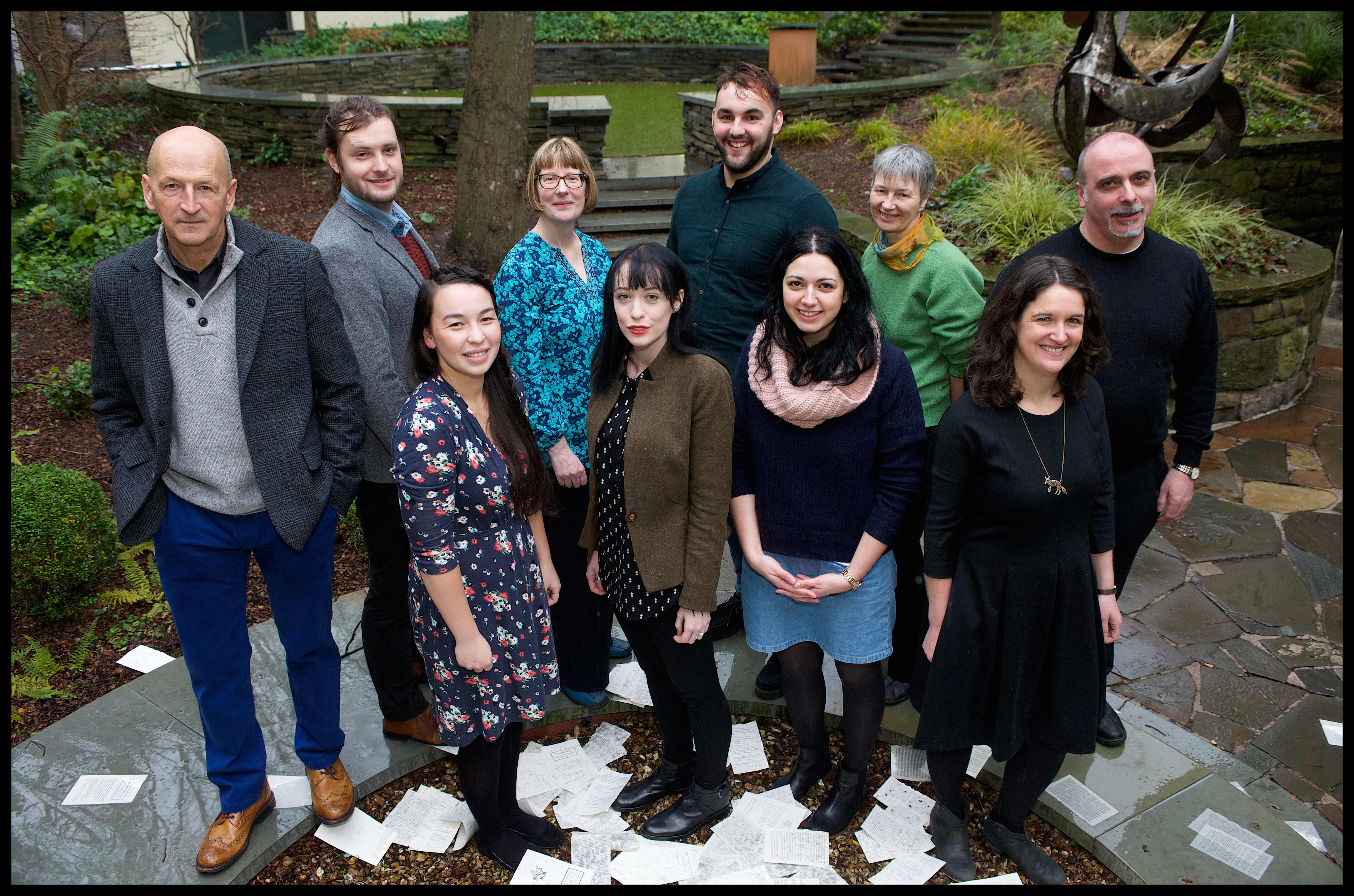
This week I’ll be chairing a Book Week Scotland event at Stirling Central Library. It’s a ‘ThankBooks’ panel, featuring several writers (Alan Bissett, Lisa Ballantyne, Billy Letford and Shari Low) who will be talking about a book, author, character or library that made them what they are today.

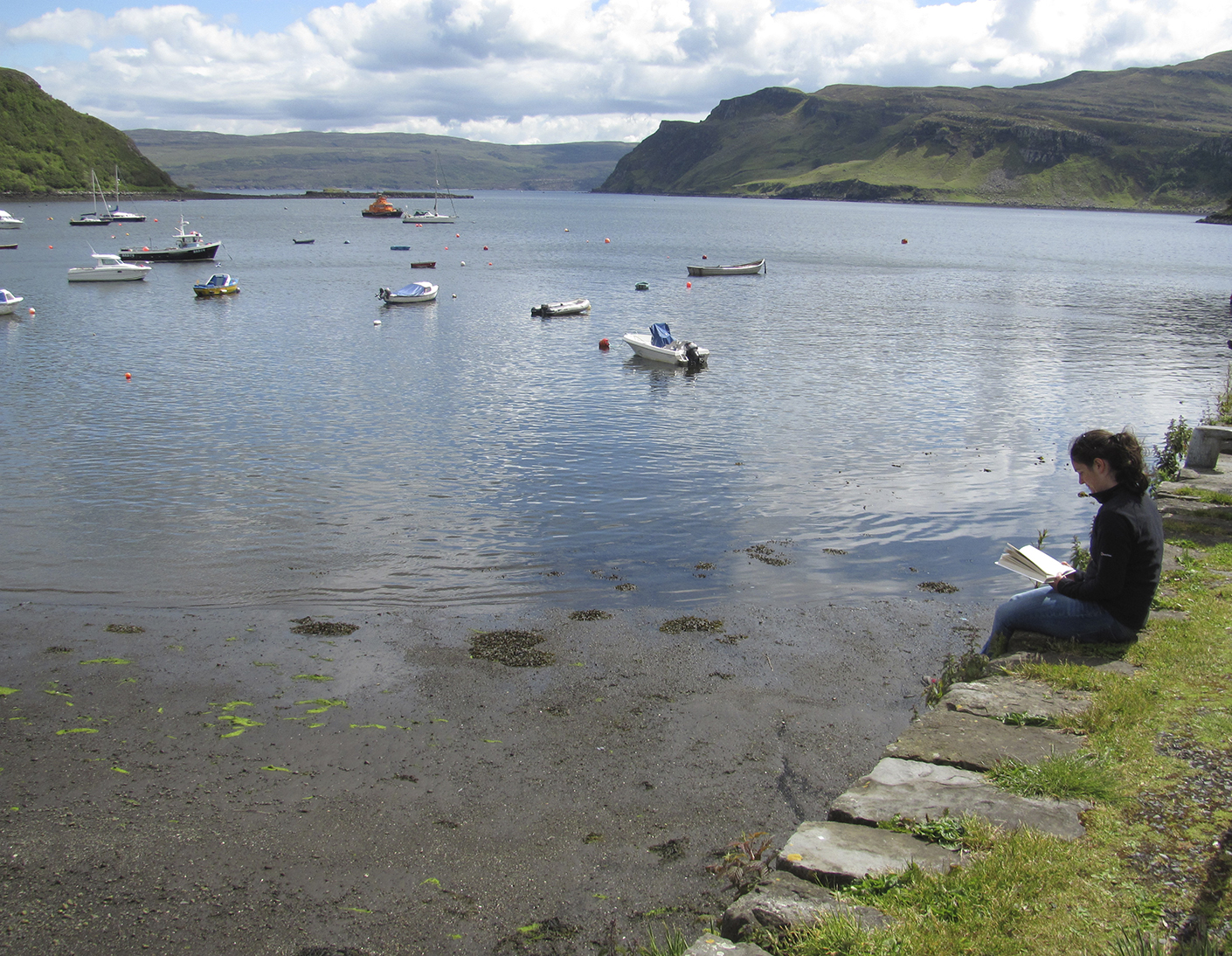
C7 (2)Preparing for the panel has made me think about my own early reading and writerly inspirations. I was a bookish child: here’s me with my nose in a big book of fairy tales, one of my favourites when I was little. Perhaps no surprise that when I came across Angela Carter’s The Bloody Chamber and Other Stories as an adult I loved its exhilarating, weird, erotic feminist retellings. Who can forget the moment in the title story when the mother gallops, gun blazing, to snatch her daughter from the hands of the murderous Marquis? Or the ‘wily, perspicacious and resourceful’ Puss-in-Boots, who ‘can perform a back somersault whilst holding aloft a glass of vino in his right paw and never spill a drop’? (After reading this stuff, real life is always going to seem a little grey.)

My favourite book of all as a little girl was J M Barrie’s Peter Pan and Wendy, which I read innumerable times. I had an edition with the Mabel Lucie Attwell illustrations, and my parents copied me out a flying Peter Pan on a big piece of paper, which I had stuck to the lampshade in the middle of my bedroom. In my head, though, the story was much wilder than the charming illustrations suggested: the interloper boy who steals the children away from the security of their home to fly across the skies to Neverland couldn’t be tamed. Many years later, I delighted in Geraldine McCaughrean’s official sequel, Peter Pan in Scarlet (commissioned to continue the flow of royalties to Great Ormond Street Hospital) which perfectly captured Peter Pan’s wildness and prickliness. Continue reading

Calais: in the warm embrace…

The borders of Europe are in crisis, we are told. People are moving en masse, escaping war, persecution, and – in a least-worst scenario – appalling poverty. The particular focus for the British media is the thousands of migrants in Calais’s ‘Jungle’, who are attempting to come to the UK via the Channel Tunnel, risking horrific injury, or death.

Some of our politicians (including those in power), and parts of the media, have taken to using language to describe the migrants that is entirely dehumanising. In so doing, the people of the ‘swarm’ are robbed of their individuality, their histories, and their narratives. We are robbed of our compassion, and our understanding of our privileged place in the world. And they, and we, are robbed of our common humanity.

The Burghers of Calais

The Burghers of Calais

A much higher number of migrants is currently arriving on other, poorer European shores: Greece, and Italy. The UK concentration on Calais in itself betrays a limited worldview, forgetting the greater contribution others in the EU are making to homing asylum seekers. Yet for this ‘crisis’ to be happening in Calais is, for me, of particular resonance.

My father is English, my mother French. Every summer holiday when we were children, for several weeks (my parents both being school teachers) we’d pack the bags, the car, feed the cassette player, and head south. It was a few hours journey from Lincolnshire to Dover, then the ferry – where the sun would always start to shine – and, after a little queuing to get off the ferry and into France – onto the smooth and (relatively) empty autoroutes. We’d stop off overnight with relatives in Paris, and head further south the next morning, braving the hectic traffic on the Peripherique. Further south still, we’d reach the watershed, where the water divides across France – to the west coast or the south. Then finally, several sticky, argumentative hours later, to my grandparents’ flat.

We’d stay for four weeks or so, sometimes heading off on a holiday within a holiday, to Provence, or the Alps. We’d spend days reading, swimming, sunbathing, playing cards, watching the August meteor showers… the same ‘etoiles filantes’ which are currently raining down over our heads.

Continue reading

BooksfromScotland.com extract

BooksfromScotland.comBooks From Scotland has just relaunched its website, which showcases the work of writers and publishers from Scotland.

The first issue of the new website, which will be updated monthly, includes an extract from my work in progress. To read more, head over to the BooksfromScotland.com website. Thanks to the team for including some of my work!

There’s also an extract on this website, over on the Writing page.

Have you put full stops at the end of sentences?

Some weeks ago, I received a letter from my parents. Included within it were some probing questions from my dad about the book I’m writing.

As it’s Father’s Day, I thought it would be an appropriate moment to share these. (Dad is not a writer, by the way, though his letters can be rather good.)

So here, for any of you writers out there, are the questions you should be asking yourselves:

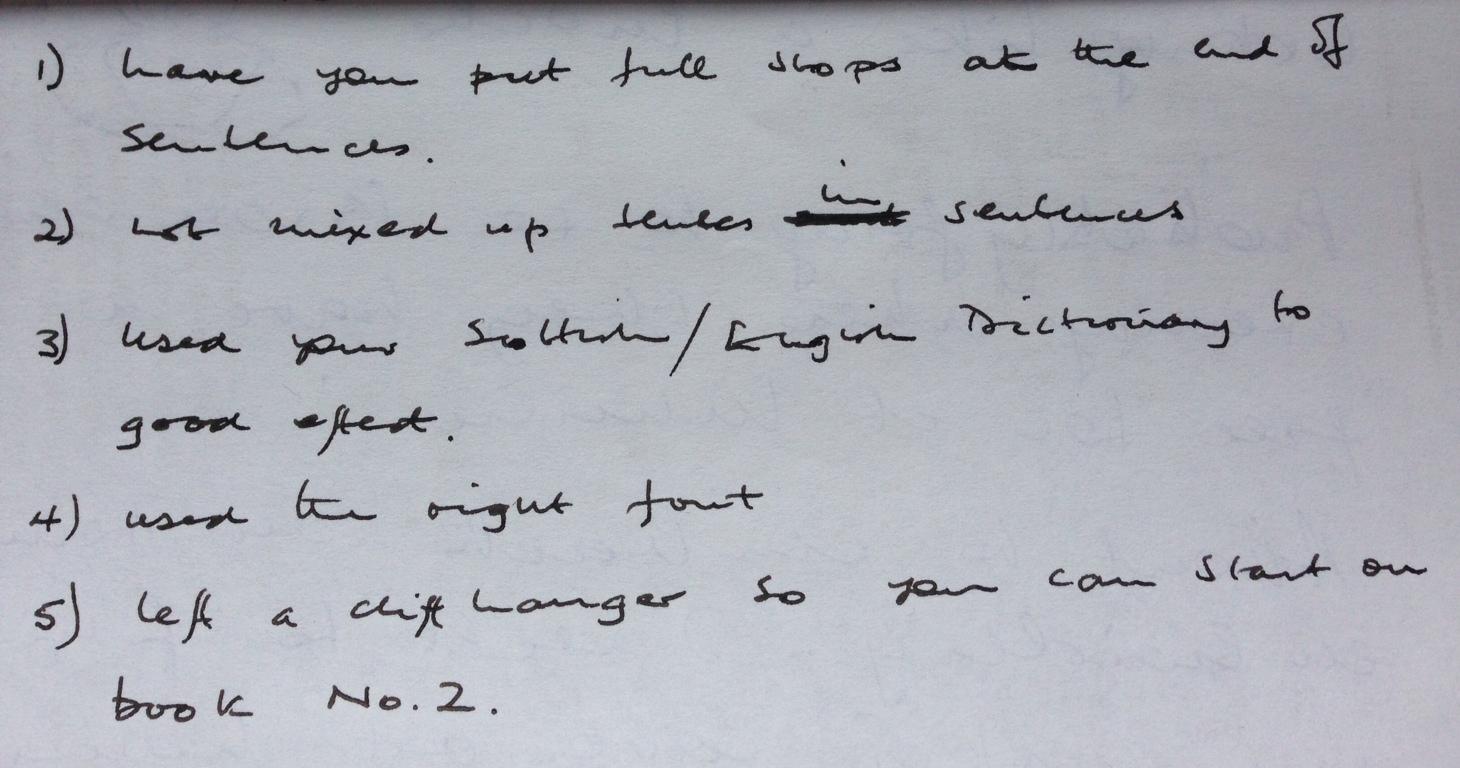
  1. In your bookHave you put full stops at the end of sentences?
  2. Have you not mixed up tenses in sentences?
  3. Have you used your Scottish/English Dictionary to good effect?
  4. Have you used the right font?
  5. Have you left a cliffhanger so you can start on book No.2?

It’s a tongue-in-cheek list, but actually it’s pretty useful.

So how am I doing? I’m fairly sure I’ve managed 1, 2 and 4. Number 3 needs some work. And 5… hmm. Watch this space!


26 Winters

musuem-of-childhoodI’ve just heard that I’m going to be involved in an exciting project, which will take me both from summer into winter, and adulthood into childhood.

The writers’ collective 26 recently put out a call for contributors to a project in collaboration with Edinburgh’s Museum of Childhood. 26 writers will each be allocated an object from the Museum’s collections, and asked to write a ‘sestude’ about it – a work consisting of 62 words. The objects – and our sestudes – will then be revealed in an online advent calendar in the lead-up to Christmas. This, alongside an exhibition in the museum, will raise money for the charity It’s Good 2 Give.

I’m already wondering about my object: will it be skittles? A hula hoop? Something more seasonal – a pair of ice skates?

And are hyphenated words counted as one word or two? By my reckoning, this blog is already nearly 150 words long, so I’m hoping a bit of hyphenation might help me sneak in an extra word or two. I expect our editors will be very strict, though, and something unpleasant* from the School Days section of the Museum will be used on me if I cheat.

You can follow what we’re getting up to on Twitter using the #26Winters hashtag.

*Apparently they have a cane and leather tawses.